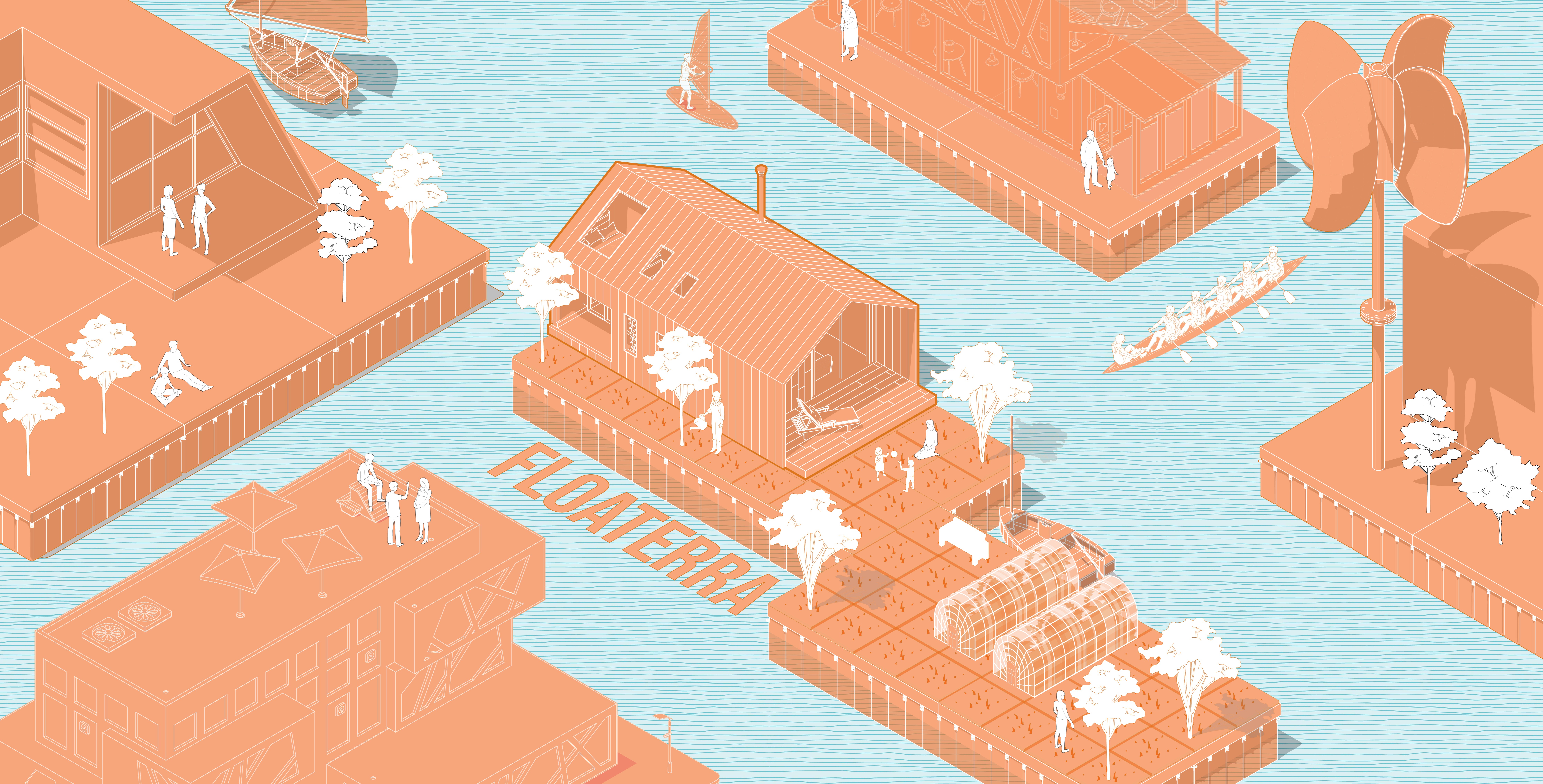
Dystopia fundamentally entails a specific way of abstraction of thought, where imagined future(s) - with a strong emphasis on the word imagined - are plotted in speculation. The core of the objective here is to foreground another important but often misplaced ideation (within the context of dystopian thought), which is the inevitability of cause and effect. A chain of events - let’s imagine a meteor headed towards the planet - the inevitability is only imagined until it’s not. Limitations of space are a reality that demands constant adaptations of thought and action. Grounding the perspective in an exploration of current global space, the rising sea levels, and the enclosure of habitation as it is now, in the purest sense of the word, clear that a new way of imagining the future is necessary. The acceleration of global temperature which is constantly fed by the fast-paced economic and political landscape of the modern world is one such inevitability that needs to be addressed.
The framework of architecture and urban planning presents an opportunity to rethink the manipulation of space to adapt to the very real imagined problems of the presented dystopia. It is imperative to delineate problems faced by communities around the world specific to their geographical contexts, in this case, the submersion of land by the enclosing water bodies agitated due to the exhaustion of resources by so-called sustainable free-market capitalism. This research proposes the hypothesis and design of floating cities in a two-fold approach - it looks to carve concrete pathways of thought in a theoretical attempt to invent a new reality of habitation as opposed to a traditional conception of a city and placing current global realities of specific living communities within their social and environmental challenges. There is a growing academic obsession with the thought of design and planning to create secluded spaces within the space of a city. A contorted space, for the lack of a better phrase - a city within a city. This tendency within the discipline breeds cultural alienation. In saying that this research looks to elaborate further by interpolating the work and prior research about the same within the framework of meta-physics of architecture. The study resurrects the images and technicalities of submerged settlements, illuminating the conditions for contemporary floating communities.
A Comprehensive study of Resilient design for buoyant settlements
The established framework presents a level of inevitable instability - climate conditions etc, mandating a flexible design principle rooted in cultural space manipulation. The utility of material need and the following sustainability of the same is contextualized for a landmass that is compromised or in a kafkaesque sentiment, constantly in the anxiety of becoming.